



Introduction
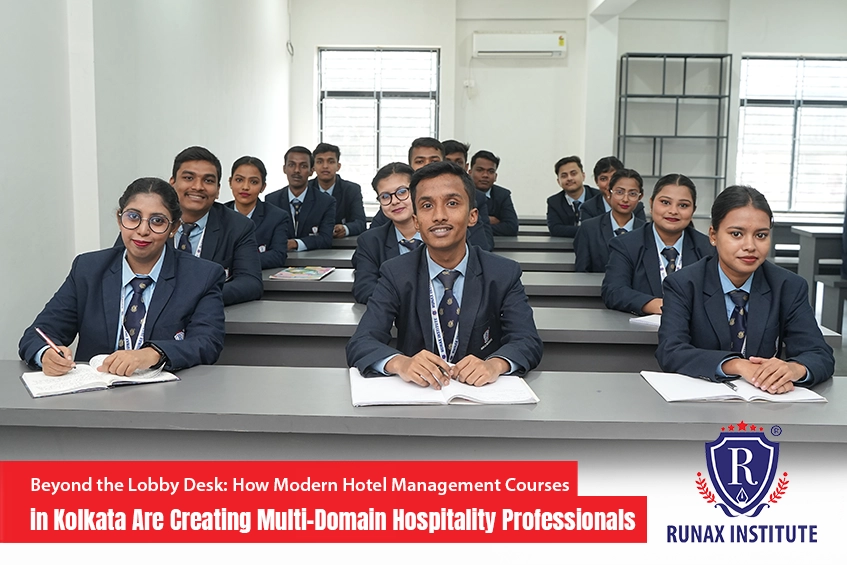
You have probably thought that hotel management courses in Kolkata were all about smiling at guests and handing over room keys? Well, think again. The hospitality industry has undergone a massive transformation, and educational programs have evolved right alongside it. Students walking into today’s top hotel management institute in Kolkata aren’t just learning how to manage a front desk anymore.
They’re being trained as multifaceted professionals who can whip up a five-course meal, manage operational analytics, understand customer psychology, coordinate events, and navigate digital communication platforms with equal confidence. The stakes are high. Graduates who stick to outdated, single-domain training risk entering an industry that has already moved several steps ahead. Hotels now demand professionals who can seamlessly switch between departments, understand technology-driven operations, and adapt to changing customer expectations across multiple service sectors.
If you keep reading, you’ll discover exactly how modern hospitality management courses are equipping students with cross-functional expertise that opens doors far beyond traditional hotel roles. This goes beyond simply finding employment. It’s about building a career that spans aviation, cruise lines, luxury retail, food service, tourism, and international hospitality markets where versatility matters more than ever before.
The Transformation of Hotel Management Education in Kolkata
The hospitality industry is no longer just about hotels. Airlines need service professionals. Cruise ships hire hospitality graduates. Event management companies seek trained coordinators. Food service chains require operational managers. Customer experience has become a specialised field in itself. This shift has forced hotel management colleges to completely redesign their curricula. Traditional programs focused narrowly on hotel operations, teaching students to handle specific departments without much crossover.
Modern courses now integrate culinary arts, customer psychology, digital reservation systems, operational analytics, and business communication into comprehensive learning frameworks. According to recent industry reports, approximately 68% of hospitality employers in India now prefer candidates with multi-domain training over those with single-department specialisation. The change reflects global service industry trends where adaptability determines career longevity. Top hotel management institutes in Kolkata have responded by developing infrastructure-driven, industry-oriented educational models.
Modern training facilities now include fully equipped commercial kitchens, simulated front office environments, housekeeping labs, food and beverage service areas, and technology-integrated operational spaces. Students experience actual work conditions during their academic journey. This experiential approach bridges the gap between classroom theory and professional execution, ensuring graduates enter the workforce already familiar with real hospitality environments.
Moving Beyond Traditional Hospitality Roles Through Multi-Domain Learning
The days when hospitality training institutes produced graduates for narrowly defined roles have ended. Front office executives were trained exclusively for reception duties. Culinary students focused only on kitchen operations. Housekeeping professionals learned room maintenance without understanding broader operational contexts. Modern education refuses these artificial boundaries. Students now receive comprehensive exposure across all major hospitality domains simultaneously. A typical curriculum includes front office management training, culinary arts training, housekeeping management training, and food and beverage service components integrated into progressive learning modules.
This multi-domain approach serves multiple strategic purposes. First, it helps students identify their natural strengths and career preferences through practical exposure rather than theoretical speculation. Second, it creates professionals who understand how different departments interconnect within hospitality operations. Third, it dramatically expands employment opportunities because graduates can adapt to various roles across different service sectors. Industry data suggests that hospitality professionals with cross-functional training experience 42% faster career advancement compared to single-domain specialists.
The versatility becomes particularly valuable during career transitions, geographic relocations, or industry shifts. A graduate trained in multiple domains can move from hotel operations to airline services, from restaurant management to cruise line hospitality, from event coordination to luxury retail customer experience. The hospitality career development trajectory becomes significantly broader and more resilient against market changes and economic fluctuations that might affect specific sectors.
Front Office Training as the Foundation of Service Communication
Every hospitality interaction begins at the front desk. Front office management training serves as the foundational component of modern hotel management courses in Kolkata because it develops essential communication and customer engagement capabilities. Students learn reservation handling through property management systems, guest check-in and check-out procedures, payment processing, complaint resolution, and cross-departmental coordination. The training goes far deeper than operational mechanics.
Front office education teaches students how to read customer emotions, adapt communication styles to different personality types, manage conflicts diplomatically, and maintain professionalism under pressure. Simulated hospitality environments allow students to practice handling difficult situations without real-world consequences. Role-playing exercises cover scenarios like overbooked rooms, billing disputes, special accommodation requests, emergency responses, and VIP guest management. This practical exposure builds confidence and interpersonal intelligence that textbooks cannot provide. Research indicates that approximately 73% of guest satisfaction in hotels directly correlates with front office interaction quality.
Understanding this psychological dimension becomes critical for hospitality professionals. Customer service training in hospitality emphasises emotional awareness, cultural sensitivity, and adaptive communication strategies. Students learn how first impressions shape entire guest experiences and how consistent service quality builds brand reputation. The front office becomes a training ground for understanding human behaviour, service psychology, and operational coordination that applies across all hospitality sectors and customer-facing industries.
Culinary and Food Production Training in Modern Hotel Management Courses
Food is central to hospitality. Whether guests check into hotels, board cruise ships, attend events, or visit restaurants, culinary experiences shape their overall satisfaction levels. Modern hotel management courses in Kolkata recognise this reality by making culinary arts training a mandatory component rather than an optional specialisation. Students receive hands-on exposure to food production systems, kitchen organisational structures, hygiene protocols, menu planning principles, ingredient sourcing, cooking techniques, presentation standards, and cost management strategies.
Practical hotel management training includes working in fully equipped commercial kitchens where students prepare actual dishes under professional supervision. The experience teaches technical skills like knife handling, temperature control, timing coordination, and recipe execution. Beyond techniques, culinary training develops discipline, creativity under constraints, attention to detail, and teamwork capabilities essential in high-pressure kitchen environments. Industry statistics reveal that food quality accounts for approximately 34% of overall guest satisfaction in full-service hotels. Students who understand culinary operations gain strategic advantages in hospitality careers because they comprehend one of the most operationally complex and customer-sensitive departments.
The training also opens alternative career pathways in standalone restaurants, catering services, food production companies, culinary consultancy, menu development, and food service management across healthcare, education, and corporate sectors. Understanding kitchen operations makes hospitality professionals more effective managers because they can evaluate operational efficiency, cost structures, quality standards, and team performance from informed perspectives rather than theoretical assumptions.
Housekeeping Management and the Science of Operational Precision
Housekeeping often gets overlooked in discussions about hospitality careers, yet it represents one of the most operationally intensive and quality-critical departments in any service establishment. Housekeeping management training within modern hospitality management courses focuses on room maintenance standards, sanitation protocols, inventory management, laundry operations, public area maintenance, quality assurance processes, and efficiency optimisation strategies. Students learn that housekeeping is fundamentally about operational precision and consistency. A single missed detail can compromise guest satisfaction and damage brand reputation.
Training includes practical sessions in maintaining different room types, handling various cleaning equipment, managing chemical usage safely, coordinating linen operations, and conducting quality inspections systematically. The discipline develops attention to detail, workflow efficiency, time management, and quality consciousness that transfer to other professional contexts. Research shows that housekeeping quality directly influences approximately 41% of guest decisions regarding return visits to hotels. This makes housekeeping management a strategic function rather than just a maintenance operation.
Students trained in housekeeping understand operational standards, resource optimisation, team coordination, and quality control principles that make them valuable across hospitality sectors. The training also teaches sustainability practices, eco-friendly cleaning methods, waste management, and energy conservation strategies – increasingly important in environmentally conscious hospitality operations. Graduates with housekeeping expertise find opportunities in hospital administration, facility management, cruise operations, resort management, and corporate housekeeping services where operational excellence determines organisational success.
Food and Beverage Service Training for Real-Time Hospitality Operations
Food and beverage services represent the most visible and guest-interactive component of hospitality operations. Modern hotel operations training emphasises F&B service because it develops coordination, timing precision, presentation skills, and customer interaction capabilities simultaneously. Students participate in restaurant-style practical sessions that simulate actual dining environments. Training covers table setting standards, service sequences, menu knowledge, wine service protocols, guest handling techniques, order coordination, billing procedures, and conflict resolution strategies.
The experience teaches operational rhythm, situational awareness, and adaptive service delivery based on customer preferences and dining contexts. F&B service training goes beyond mechanical procedures to address service psychology and customer experience design. Students learn how service timing affects guest satisfaction, how presentation influences perceived value, how staff behaviour shapes dining atmosphere, and how personalised attention creates memorable experiences. According to hospitality industry studies, service quality accounts for approximately 52% of restaurant customer satisfaction ratings, making it the single most influential factor.
Practical F&B training prepares students for high-pressure service environments where mistakes are immediately visible, and customer expectations constantly evolve. The skills developed through food and beverage service training transfer effectively to airline hospitality, cruise dining operations, event catering, luxury retail customer service, and any professional context requiring coordinated service delivery under time constraints with direct customer interaction and quality accountability.
Technology Integration in Modern Hotel Management Courses
Digital transformation has revolutionised hospitality operations. Manual reservation systems have been replaced by sophisticated property management platforms. Customer data analytics drive personalised service strategies. Mobile apps enable contactless check-ins. Smart room controls enhance guest experiences. Revenue management software optimises pricing strategies. Modern hotel management courses in Kolkata integrate technology training throughout their curricula to prepare students for digitally driven operational environments.
Students learn industry-standard hospitality management software, digital reservation systems, customer relationship management platforms, point-of-sale systems, inventory management applications, and operational analytics tools. The training ensures graduates enter workplaces already familiar with the technologies they will use professionally. Technology integration extends beyond software training to include understanding how digital systems transform operational workflows, enhance efficiency, improve accuracy, and enable data-driven decision making. Students learn how property management systems coordinate information across departments, how analytics reveal customer behaviour patterns, how automation reduces manual errors, and how digital communication platforms streamline operational coordination.
Industry reports indicate that approximately 78% of hotels globally now use integrated technology platforms for core operations, making digital literacy essential for hospitality professionals. Top hotel management institutes in Kolkata recognise that technology skills determine career advancement potential. Graduates comfortable with digital systems adapt faster to new roles, contribute more effectively to operational improvements, and position themselves for management responsibilities requiring strategic use of data and technology in competitive hospitality markets.
Industry Exposure and Internship-Based Professional Development
Theory creates knowledge. Practice builds capability. Modern hospitality training institutes emphasise hotel management internships and hospitality industry exposure programs as critical components of professional development. Students transition from controlled academic environments to actual hospitality workplaces where customer expectations are real, operational pressures are genuine, and mistakes have consequences. Internships provide exposure to workplace culture, team dynamics, customer diversity, operational challenges, and professional standards that classrooms cannot replicate.
Students experience how theoretical concepts translate into practical execution, how operational decisions affect multiple departments, how customer service requires constant adaptation, and how professional success depends on reliability, initiative, and continuous learning. Research indicates that hospitality graduates with structured internship experience demonstrate 63% higher initial job performance ratings compared to those without practical industry exposure. The experience builds confidence, adaptability, problem-solving abilities, and professional maturity essential for career success. Industry-integrated hotel management programs create partnerships with hotels, restaurants, resorts, event companies, and service organisations that provide students with diverse practical experiences across different hospitality contexts.
These collaborations ensure training remains current with industry practices, technological changes, and evolving customer expectations. Internships also serve as extended job interviews where students demonstrate capabilities, and employers evaluate potential hires, frequently leading to employment offers for strong performers. The professional network developed during industry exposure becomes valuable throughout hospitality careers as former supervisors, colleagues, and mentors provide guidance, references, and career opportunities.
Personality Development and Soft Skill Training in Hospitality Education
Technical skills get you hired. Personality keeps you employed and promoted. Modern hospitality management courses recognise that professional success requires more than operational competence. Students need communication excellence, professional grooming, emotional intelligence, teamwork capabilities, leadership potential, stress management skills, and cultural sensitivity to thrive in customer-facing hospitality careers. Customer service training in hospitality includes structured personality development modules focusing on verbal and non-verbal communication, professional presentation, confidence building, active listening, empathy development, and interpersonal effectiveness.
Students participate in group discussions, presentation sessions, mock interviews, role-playing exercises, and feedback sessions that develop self-awareness and communication skills. Grooming and personal presentation receive significant attention because first impressions influence customer perceptions and professional credibility. Students learn appropriate attire standards, personal hygiene expectations, body language principles, and professional demeanour required in hospitality environments where appearance directly affects brand image and customer confidence. Industry studies reveal that approximately 67% of guest satisfaction stems from staff behaviour and attitude rather than facility quality alone.
This makes personality development and soft skills training strategically important for hospitality professionals. Modern hotel management courses in Kolkata integrate personality development throughout academic programs rather than treating it as supplementary training. Regular workshops, mentoring sessions, and practical exposure opportunities continuously develop students’ professional personalities, ensuring graduates enter careers as polished, confident, service-oriented professionals capable of handling diverse customer interactions and workplace responsibilities effectively across domestic and international hospitality markets.
Expanding Career Opportunities Through Multi-Domain Hospitality Expertise
Traditional hotel management courses in Kolkata prepared students primarily for hotel employment. Modern programs recognise that hospitality skills apply across numerous industries and service sectors. Aviation companies hire hospitality graduates for cabin crew, ground services, and airport customer experience roles. Cruise lines employ them for shipboard operations, entertainment coordination, and guest services. Event management companies seek them for conference coordination, wedding planning, and corporate event execution. Luxury retail brands value their customer service expertise. Tourism companies need them for travel coordination and customer experience management.
Corporate organisations employ hospitality graduates for facility management, corporate hospitality, employee services, and client relationship roles. Healthcare facilities hire them for patient experience management and administrative coordination. Educational institutions use hospitality professionals for campus operations and student services. This career diversity exists because hospitality education develops transferable skills applicable wherever customer service, operational coordination, and professional service delivery matter. Multi-domain training amplifies this versatility by ensuring graduates understand multiple operational areas rather than narrow specialisations. Research indicates that hospitality graduates with cross-functional training have approximately 3.7 times more job opportunities compared to single-domain specialists.
The ability to adapt across different service contexts, understand diverse operational requirements, and apply hospitality principles in varied professional environments makes multi-domain graduates valuable across industries experiencing increased focus on customer experience, service quality, and operational excellence. Hospitality career development trajectories extend far beyond traditional paths, offering diverse opportunities in domestic and international markets where service industries continue expanding, and professional service delivery becomes increasingly valued.
Building Future Hospitality Leaders Beyond Conventional Hotel Roles
The hospitality industry needs leaders who think beyond traditional operational frameworks. Modern hotel management courses in Kolkata aim to develop strategic thinkers who understand business economics, customer psychology, operational analytics, technological integration, sustainability practices, and service innovation. Students trained in multi-domain frameworks with practical exposure and industry integration emerge as adaptable professionals prepared for evolving global service industries.
Educational programs emphasising experiential learning, cross-functional training, and real-world application create graduates who transition smoothly from academic environments to professional careers. They understand how hospitality operations function holistically rather than departmentally. They recognise how technology transforms service delivery. They appreciate how customer expectations continuously evolve. They adapt to different cultural contexts in international hospitality markets. They apply hospitality principles across diverse service sectors. Top hotel management institutes in Kolkata, focusing on comprehensive professional development rather than narrow technical training, produce graduates positioned for leadership roles across hospitality and service industries.
These professionals become department managers, operational supervisors, training coordinators, customer experience strategists, business development executives, and eventually organisational leaders who shape service standards, operational strategies, and customer experience frameworks. The transformation from traditional hotel-focused education to multi-domain professional development reflects broader changes in service economies where versatility, adaptability, and cross-functional expertise determine career success and organisational value in increasingly competitive and globally connected hospitality markets.
Conclusion
The evolution of hotel management courses in Kolkata represents a fundamental shift in how hospitality education prepares professionals for modern service industries. Traditional programs focused narrowly on hotel operations have given way to comprehensive multi-domain learning frameworks that develop versatile professionals capable of adapting across diverse hospitality sectors. Students now receive integrated training in front office management, culinary arts training, housekeeping management training, food and beverage service, technology integration, customer psychology, and operational analytics through industry-oriented academic structures emphasising practical exposure and experiential learning.
This transformation addresses market realities where hospitality employers increasingly value cross-functional expertise, technological literacy, adaptability, and comprehensive operational understanding over narrow specialisation. Graduates emerge from modern hospitality management courses prepared for careers spanning hotels, aviation, cruise lines, event management, luxury retail, tourism, and corporate services, where customer experience and professional service delivery drive competitive advantage. The integration of practical hotel management training, hospitality industry exposure programs, personality development, and soft skill enhancement creates polished professionals ready for domestic and international hospitality markets. Institutions emphasising comprehensive professional development produce graduates who become operational excellence drivers, customer experience strategists, and future hospitality leaders capable of navigating evolving service industry demands.
The future belongs to hospitality professionals who think beyond conventional boundaries, adapt across operational contexts, leverage technology effectively, and deliver exceptional customer experiences consistently. Modern hotel management courses in Kolkata are creating exactly these professionals through multi-domain learning, practical industry integration, and holistic professional development approaches that redefine hospitality education for global service economies.
Frequently Asked Questions
Q1: What career options exist beyond traditional hotel jobs for hospitality management graduates?
Graduates find opportunities in aviation, cruise operations, event management, luxury retail, tourism, corporate hospitality, facility management, healthcare administration, and customer experience roles across service industries, valuing professional service delivery and operational excellence.
Q2: How does multi-domain training improve employability compared to specialised hospitality education?
Cross-functional training provides operational versatility, broader skill sets, adaptability across service sectors, and a comprehensive understanding of hospitality operations, resulting in approximately 3.7 times more job opportunities compared to narrow specialisation.
Q3: Why is practical industry exposure important in hotel management education?
Internships and industry exposure bridge academic learning with professional execution, develop workplace confidence, enhance problem-solving abilities, provide operational understanding, and frequently lead to employment opportunities through extended job interviews.
Q4: How has technology changed modern hospitality operations and training requirements?
Digital reservation systems, property management platforms, customer analytics, mobile applications, and operational automation now drive hospitality operations, making technology literacy essential for professional success and career advancement in modern service industries.
Q5: What soft skills are most important for hospitality professionals?
Communication excellence, emotional intelligence, professional grooming, teamwork capabilities, stress management, cultural sensitivity, adaptability, and customer service orientation determine professional success since guest satisfaction depends largely on staff behaviour and attitude.