






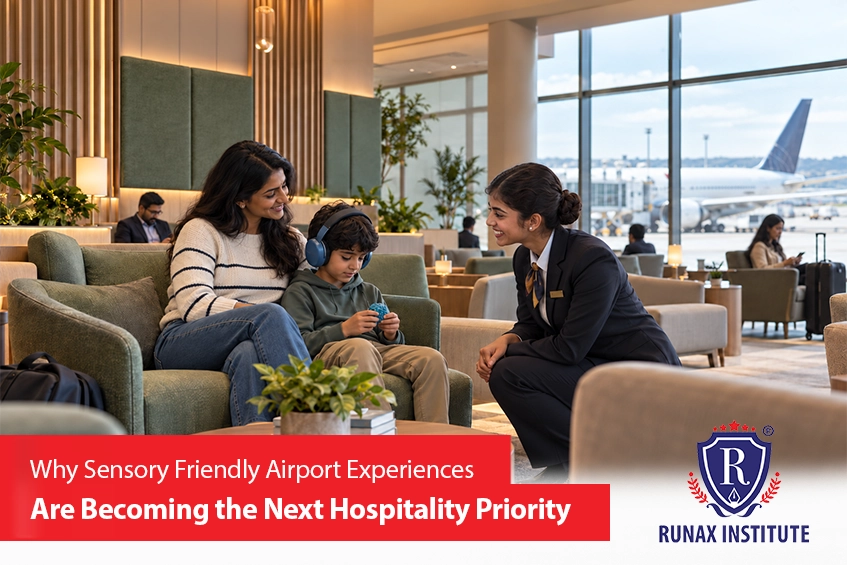
Airports are loud, bright, and crowded. For many travellers, that is a small annoyance. For others, it becomes a wall. Imagine a boy who adores aeroplanes. He reaches the terminal, hears overlapping announcements, sees flickering screens, and feels a crowd pressing in. His parents watch him shut down before they even reach security.
Scenes like this happen daily, and they cost airports loyal passengers and goodwill. Many families simply stop flying. Staff often misread distress as bad behaviour and respond with the wrong words. Ignoring the problem brings real risks, including missed flights, complaints, and damaged trust.
Sensory-friendly design offers a practical fix. Airports now create quiet zones, simplify signs, train teams, and coordinate assistance more smoothly. This guide explains how those changes work and why aviation hospitality professionals must understand them. It also shows the skills a strong aviation management course in Kolkata should build, so you can design calmer journeys for every passenger.
What Is a Sensory Friendly Airport Experience?
A sensory-friendly airport reduces unnecessary noise, glare, crowding, and surprise, while keeping every safety rule intact. It does not mean a silent terminal. It means the airport provides sensitive passengers with clear information and options.
What is a sensory-friendly airport? It is an airport that adjusts its environment, signage, and staff behaviour so neurodivergent travellers and others with sensory sensitivities can move through the journey with less stress. Some passengers dislike sudden sounds. Others struggle with flickering light or strong smells. Many feel anxious when they cannot predict what happens next.
These needs affect autistic people, people with ADHD, travellers with anxiety, older adults with dementia, and many children. The idea belongs to inclusive service design. Designers start with real passenger needs and build features that help many people at once. A quiet seat helps an exhausted business traveller too. A clear sign helps a first-time flyer.
Aviation teams then turn these ideas into daily service protocols. That step matters, because comfort should never depend on one kind employee being on duty. Good passenger experience comes from systems, not luck.
Why Are Sensory Friendly Airports Becoming a Hospitality Priority?
Airports now compete on experience, not only on connections. Hospitality thinking asks one simple question. How does the guest feel at every touchpoint? Sensory comfort answers a big part of that question.
A 2025 global survey of airport initiatives notes that an estimated 15 to 20 per cent of the world population is neurodivergent. The same review warns that airports are still largely not designed to include them. Poor access pushes many neurodivergent people to avoid travel or endure major distress. That means a huge group of potential customers stays away.
The industry is responding. A growing number of international airports now run sensory rooms or quiet corners. One major East Asian airport opened a sensory corner for passengers with invisible disabilities in April 2026. Another Asian hub built a 200 square metre calm room in a departure transit area. India has joined the movement too. The first Indian airport entered the sunflower lanyard network in December 2022, and the capital’s airport trained all passenger-facing staff on hidden disabilities in 2023.
Why does sensory-friendly design matter for airports? It widens the customer base, reduces complaints, and builds loyalty. It also turns accessibility into a visible service strength.
Which Airport Stressors Overwhelm Sensitive Passengers?
Airports pack many triggers into a small space. Sensitive passengers face them one after another, and the stress builds. Understanding each trigger helps managers design smarter fixes.
Noise and Unpredictable Announcements
Public address calls, boarding alerts, trolley wheels, and café machines create layers of sound. Sudden announcements are worse than steady background noise, because they arrive without warning. Written updates on screens and calm, scheduled messages can reduce the shock.
Bright Lighting and Crowds
Harsh lights and reflective floors cause glare and discomfort. Dense queues near check-in and security add physical pressure. A passenger who cannot step back from a crowd may feel trapped. Softer lighting zones and clear queue management help.
Unpredictable Processes
Security screening asks passengers to remove items, stand in unfamiliar positions, and follow fast instructions. Uncertainty drives anxiety. Sensory overload often peaks at this stage. Visual guides and simple explanations in advance let passengers know what will happen and when.
What Do Sensory Friendly Waiting Areas and Quiet Zones Include?
An effective quiet space offers more than just an empty room. It follows a clear design logic. The 2025 global survey revealed that quiet and multisensory rooms are still relatively uncommon, despite evidence showing that they help passengers manage sensory input and recover from overwhelming experiences. That gap is an opportunity for airport managers.
Strong sensory rooms usually give passengers a gentle entry, adjustable features, and space for families and caregivers. A welcoming area with luggage storage helps travellers transition from a busy terminal to a calmer environment. Adjustable lighting, comfortable seating, and sound-absorbing materials create a peaceful and relaxing space. Staff should keep a simple cleaning and maintenance routine, so the space stays inviting.
| Feature | Purpose | Practical detail |
| Quiet room | Lets passengers recover from overwhelm | Low sound, soft seating, adjustable lights |
| Welcome area | Eases the move from terminal to calm | Luggage storage and clear instructions |
| Low stimulation seating zone | Offers calm without leaving the gate area | Reduced screens, dimmed lighting, fewer announcements |
| Sensory tools | Supports self regulation | Fidget items, headphones, soft textures |
Clear signs must point to these spaces. A quiet room that nobody can find helps nobody.
How Do Simplified Wayfinding and Discreet Assistance Work?
Simple wayfinding reduces decisions, and fewer decisions mean less stress. Strong airport signs use consistent icons, plain language, and predictable placement. Visual guides, sensory maps, and step-by-step previews let passengers prepare at home. Some airports publish these resources on their websites so families can rehearse the journey.
Discreet assistance protects dignity. The sunflower lanyard programme allows passengers to discreetly indicate that they have a hidden disability without having to explain it verbally. At one major Indian airport, passengers can request a sunflower band or badge from the help desk without needing to provide a reason. Staff then know the person may need extra time or patience.
Does a sunflower lanyard guarantee faster security? No. The programme states that the lanyard gives a quiet signal to staff but does not promise fast tracking or preferential service. The 2025 global survey adds that a lanyard also does not change the physical or sensory environment. So airports must pair the lanyard with real design changes, such as quiet spaces and clearer signs. Passengers should also be aware of how to seek assistance and whom to contact for support. Posters, website pages, and boarding pass reminders can make that easy.
How Should Staff Training and Assistance Teams Work Together?
A calm space fails if staff react poorly at the door. Training turns policy into behaviour. Researchers who studied two airports with autism friendly programmes running for over five years interviewed 13 travellers, including autistic adults and parents. The programmes included face-to-face staff training, visual resources, sensory maps, and signage improvements. The researchers still recommended making these resources easier to find.
Strong training teaches staff to spot distress and respond kindly. It also teaches them to separate neurodivergent behaviour from security risk. Good practice includes these steps.
- Speak at a measured pace and use brief, easy-to-understand sentences.
- Explain each step before it happens
- Offer choices, such as a quieter route or extra time
- Avoid touching the passenger or the luggage without permission
Coordination matters as much as training. The passenger assistance team, check-in personnel, security officers, airline ground staff, and gate agents must coordinate and exchange information. A simple handoff note, given with permission, prevents the passenger from repeating the story five times. Clearly defined responsibilities ensure a smooth journey and keep routine checks on schedule, allowing assistance and standard procedures to operate together seamlessly.
What Should an Aviation Management Course in Kolkata Teach?
Kolkata’s aviation and hospitality sectors keep growing, and employers now look for graduates who understand inclusion. A strong aviation management college in Kolkata should prepare students to design services, not just follow checklists. Sensory-friendly thinking sits at the centre of airport operations, customer service, and ground handling.
Choose a programme that fulfils these areas.
- Passenger assistance and persons with reduced mobility services
- Hidden disabilities awareness and neurodivergent traveller needs
- Service recovery, communication, and conflict de-escalation
- Airport layout, signage, and queue management basics
- Coordination between security, airline, and terminal teams
- Practical labs and real service simulations
Students should also learn to measure results. Complaint trends, assistance request times, and passenger feedback show whether a protocol works. A graduate who can read these signals and adjust the service becomes valuable to any employer. Choosing the right aviation management course in Kolkata therefore shapes both your skills and your confidence.
Conclusion
Sensory-friendly airports are moving from a nice idea to a hospitality priority. An estimated 15 to 20 per cent of people are neurodivergent, and many avoid flying because terminals overwhelm them. Airports lose guests and goodwill when they ignore this group. Small adjustments can help turn that trend around.
Quiet zones and sensory rooms give passengers a place to recover. Simplified wayfinding reduces confusion. Discreet tools like the sunflower lanyard help staff notice who needs support, although they work best alongside real environmental changes. Staff training and strong coordination between assistance teams turn good intentions into dependable service. Clear protocols let airports improve comfort without weakening security or safety rules.
Aviation hospitality professionals now need empathy, observation, and practical systems thinking. They must understand different sensory needs and translate that knowledge into everyday procedures. If you want to build this career, choose an aviation management course in Kolkata that teaches inclusive service design alongside core airport operations. Tomorrow’s best airports will welcome every traveller, and they will need people who know how.
Build an Inclusive Aviation Career with RUNAX Institute of Hotel Management
RUNAX Institute of Hotel Management offers an excellent Aviation Management course in Kolkata, set on its Excellence Campus at Baligori, Newtown. The institute focuses on hands-on learning, placement support, scholarships, and educational loan options. Admissions are open for 2026- 27.
Visit www.runaxinstitute.com to explore the course and apply online. You can also contact the admissions team at 8961629333 or email admission@runaxinstitute.com for further assistance. Take the first step today and get ready to shape the future of passenger-friendly, sensory-aware aviation hospitality.
Frequently Asked Questions (FAQs)
1. What does it mean for an airport to be sensory friendly?
It means the airport reduces noise, glare, crowding, and surprise, and gives clear information and quiet spaces. Passengers with sensory sensitivities can then travel with less stress while safety rules stay unchanged.
2. Who benefits from sensory-friendly airport services?
Autistic travellers, people with ADHD or anxiety, older adults with dementia, and children benefit most. Many other passengers also enjoy calmer spaces, clearer signs, and kinder, more patient staff support.
3. Does the sunflower lanyard speed up security checks?
No. The lanyard quietly tells staff that a passenger may need extra time or patience. It does not guarantee fast tracking, so airports should also provide quiet spaces and clear guidance.
4. How can airport staff support a passenger who feels overwhelmed?
Staff should speak slowly, explain each step, offer choices, and allow extra time. They should avoid touching the passenger without permission and guide them to a quiet zone if needed.
5. What skills should an aviation management course in Kolkata build?
Seek training that covers passenger assistance, awareness of hidden disabilities, communication, airport operations, and team coordination. Practical labs and service simulations enable students to apply inclusive practices in real airport environments.