






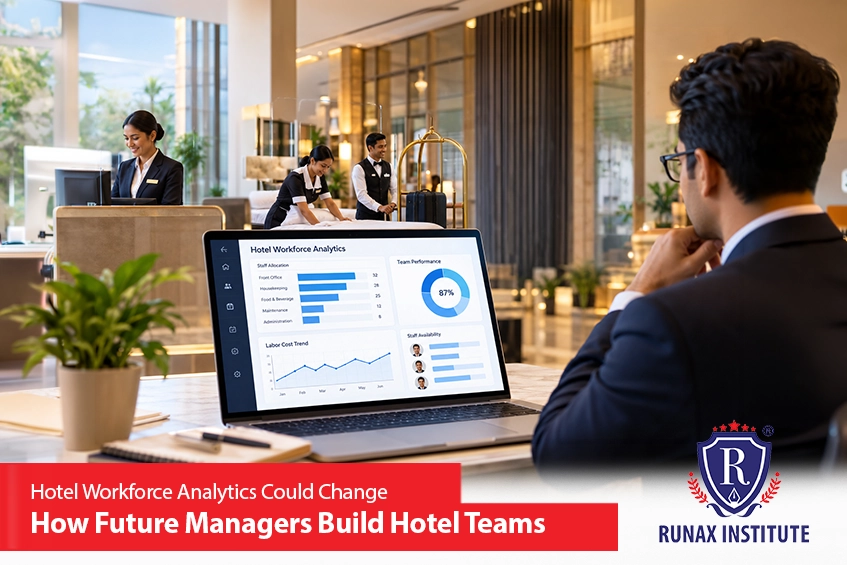
Picture a hotel manager staring at a duty roster on a Friday night, guessing how many housekeeping staff will be needed for Saturday’s checkouts. That guesswork costs money. It costs guest satisfaction. And it costs good employees who quit because they’re either overworked or underused.
If you’re exploring hotel management courses in Kolkata, you’ve probably wondered how future managers will actually solve staffing chaos rather than just react to it. The old model of hiring by instinct is breaking down fast, especially with India’s hospitality sector short by roughly 150,000 trained professionals and wrestling with attrition rates above 30%.
This blog breaks down how workforce analytics is quietly becoming the backbone of smart hotel operations, and why students enrolling in a hotel management institute in Kolkata need to understand this shift now, not after graduation.
What Is Hotel Workforce Analytics and Why Should Students Care?
Hotel workforce analytics means using operational data, occupancy numbers, guest volume, check-in patterns, and departmental workload to make staffing decisions instead of relying on gut feeling. It sounds technical, but it’s really just smarter planning dressed up in numbers.
Turning HR From an Afterthought into a Core Operations Function
For decades, HR sat in its own silo, disconnected from what was happening on the hotel floor. A front office manager dealt with guests. Housekeeping dealt with rooms. HR dealt with paperwork. That separation doesn’t work anymore. Why is workforce planning important in hotel management today? Because staffing decisions directly affect RevPAR, guest reviews, and repeat bookings. When a hotel overstaffs during a slow week, it bleeds payroll. When it understaffs during a rush, service quality collapses, and guests leave one-star reviews. Analytics connects these dots. It treats staffing like inventory, something to be forecasted, tracked, and adjusted in real time rather than fixed once a month.
Students studying operations management, front office administration, and food and beverage service benefit enormously from this mindset shift. They stop seeing HR as a separate department and start seeing it as a lever that affects every guest touchpoint. This is exactly the kind of multidisciplinary thinking that modern hospitality education needs to build, because a manager who understands both service delivery and staffing data will always outperform one who only understands one side of the equation.
How Occupancy Forecasts Are Reshaping Departmental Staffing
India’s hotel sector closed 2025 with nationwide occupancy between 63% and 65%, and average room rates climbing to roughly INR 8,500 to INR 8,700, according to HVS ANAROCK’s industry overview. By Q1 2026, occupancy had already pushed up to 67% to 69% nationally, with Delhi touching 78% to 80%. These aren’t just abstract numbers for revenue managers. They’re staffing triggers.
Front Office Staffing and Check-In Volume
A hotel expecting 80% occupancy on a Saturday needs a completely different front desk rhythm than one expecting 45%. Analytics tools now pull data from property management systems to predict check-in clusters hour by hour. This lets managers schedule extra front desk staff for a 3 PM to 6 PM rush instead of spreading the same headcount evenly across a slow morning and a chaotic evening.
Housekeeping and Room Turnover Speed
Housekeeping is the department hit hardest by unpredictable demand. How does occupancy forecasting affect housekeeping staffing? Simple. Higher occupancy means more checkout rooms needing same-day turnover, and that number is never linear. A jump from 60% to 75% occupancy can mean a 40% jump in same-day cleaning workload because of how checkout and check-in times overlap. Predictive scheduling tools flag these spikes days in advance so housekeeping supervisors can call in part-time staff instead of scrambling on the morning of.
Food and Beverage Demand Patterns
Wedding season, MICE events, and corporate bookings drive F&B staffing needs that occupancy alone doesn’t capture. March 2026 data showed most Indian hotel markets recording occupancy above 75%, driven heavily by wedding and MICE demand. A hotel relying only on room occupancy to plan banquet staffing would badly underestimate kitchen and service needs during these peaks.
Why Employee Turnover Data Deserves a Seat at the Planning Table
Have you ever wondered, “What is the average attrition rate in Indian hotels?” Hospitality is one of the highest-churn businesses in the nation, with industry estimates placing it at 30% and some reports citing figures above 40% in specific segments. That’s not a footnote. That’s a structural problem eating into training budgets, guest consistency, and team morale.
The Real Cost of Losing a Trained Employee
Replacing a trained staff member isn’t just about posting a job listing. It involves recruitment time, onboarding, lost productivity during the ramp-up period, and often a dip in service quality while the new hire learns the property’s systems. Some industry estimates suggest turnover can inflate training costs by 200% to 300% compared to retaining existing staff. When managers can see which shifts, departments, or seasons correlate with the highest exit rates, they can intervene before losing another trained employee, whether that means adjusting shift patterns, offering targeted incentives, or flagging burnout risk early.
Spotting Burnout Before It Becomes a Resignation Letter
Overtime hours, back-to-back shift patterns, and unbalanced workload distribution are all trackable metrics. A manager who notices one department consistently logging excessive overtime can act before that team starts handing in resignations. This is where data stops being abstract and starts protecting real people.
Departmental Workload Balancing: Beyond Just Headcount
Not every staffing problem is about having enough people. Sometimes it’s about where those people are placed.
Cross-Training as a Data-Driven Strategy
Analytics can reveal which departments are chronically overloaded and which have slack capacity at different times of day. This presents a compelling argument for cross-training employees who can alternate between front desk assistance and food and beverage service during regular lull-and-rush periods. A well-trained, flexible workforce responds to real demand patterns instead of rigid department boundaries.
Shift Design Based on Real Guest Behaviour
Traditional 8-hour shifts assume demand is evenly spread, which it rarely is. Data-backed shift design breaks the day into demand windows rather than arbitrary clock hours, matching staff availability to actual guest activity rather than habit or convenience.
The Technology Powering This Shift
None of this works without the right tools feeding data into decision-making.
Property Management Systems as Data Goldmines
Modern PMS platforms already capture booking patterns, length of stay, and check-in timing. Which technologies support hotel workforce analytics? Cloud-based PMS integrated with scheduling software, AI-driven demand forecasting tools, and dashboards that translate raw booking data into staffing recommendations are becoming standard across mid-size and large properties. Hotels using integrated systems report meaningfully stronger RevPAR performance and better upsell conversion because staff are positioned where guest interactions actually happen.
AI-Assisted Scheduling Tools
AI scheduling tools now factor in historical patterns, weather, local events, and even flight arrival data to predict staffing needs days or weeks ahead. This doesn’t replace the manager’s judgment. It provides a better starting point for that assessment.
What This Means for the Next Generation of Hotel Managers
Future managers won’t just need people skills. They’ll need comfort with dashboards, forecasting tools, and basic data literacy layered on top of traditional hospitality training.
Blending Soft Skills with Data Fluency
A manager who can read a demand forecast but can’t calm down an upset guest is only half-equipped. Equally, a manager with excellent people skills but no ability to interpret a staffing dashboard will keep making the same reactive mistakes. How can hotel management students prepare for a data-driven hospitality career? By building exposure across front office, housekeeping, and F&B operations during their training, so they understand how staffing decisions ripple across departments, not just within one silo.
Why Multidisciplinary Training Matters More Than Ever
Programs that rotate students through multiple operational areas, rather than narrowly specialising too early, produce graduates who instinctively understand how a housekeeping delay affects front office wait times, or how an understaffed kitchen slows banquet turnaround. That cross-departmental fluency is exactly what workforce analytics rewards.
Conclusion
Hotel workforce analytics is quietly rewriting the rulebook for how hotels staff their teams. Instead of guessing, managers now forecast. Instead of reacting to turnover after it happens, they spot the warning signs early.
Occupancy data, departmental workload patterns, and attrition tracking are no longer back-office statistics. They’re operational tools shaping guest experience in real time. For anyone considering hotel management courses in Kolkata, this shift matters because tomorrow’s managers won’t just supervise people.
They’ll interpret data to build stronger, more balanced teams. A strong hotel management institute in Kolkata should be preparing students for exactly this reality, blending operational training across departments with the analytical thinking that modern hospitality careers now demand.
Ready to Build the Skills Future Hotel Managers Actually Need?
If workforce analytics is shaping how hotels operate, your training should reflect that reality. Choosing among hotel management courses in Kolkata means looking for programs that go beyond textbook service standards and actually expose you to front office, housekeeping, and F&B operations together. That’s how you build the instinct for spotting staffing gaps before they become guest complaints. Explore your options, ask institutes how they integrate operations training across departments, and start building a career that’s ready for where hospitality is actually heading, not where it used to be.
Frequently Asked Questions (FAQs)
1. What is hotel workforce analytics?
It’s the practice of using operational data like occupancy, check-in volume, and turnover rates to plan staffing across hotel departments instead of relying on guesswork or fixed schedules.
2. Why is employee turnover such a big problem in Indian hotels?
Attrition in Indian hospitality regularly exceeds 30%, driven by wage stagnation, unclear career paths, and burnout, which raises training costs and hurts service consistency significantly.
3. How does occupancy data influence housekeeping staffing?
Higher occupancy means more same-day room turnovers. Forecasting tools predict these spikes in advance so housekeeping teams can schedule extra staff before the rush hits.
4. Do hotel management students need technical or data skills today?
Yes. Understanding basic dashboards and forecasting tools alongside traditional service training helps future managers make smarter, faster staffing decisions on the job.
5. What should I look for in a hotel management institute in Kolkata?
Look for programs offering hands-on exposure across front office, housekeeping, and F&B operations, since real-world staffing decisions depend on understanding how these departments interact.