




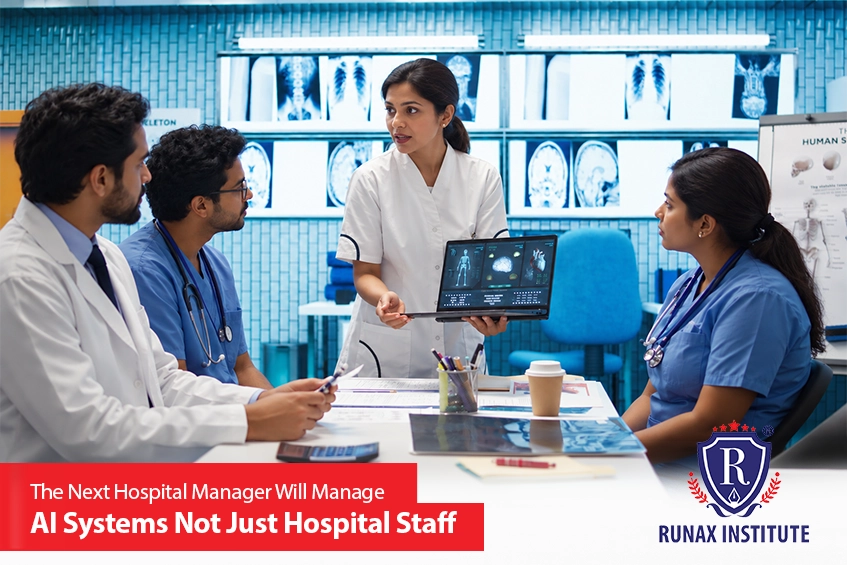
Picture a hospital administrator in 2026. She checks bed occupancy on a predictive dashboard, reviews an AI-generated discharge summary, and approves a machine-suggested duty roster before her morning coffee gets cold. This is not science fiction. This is the daily reality shaping every hospital management course in Kolkata right now. Students who once trained only in patient flow and staff rostering must now understand algorithms, data dashboards, and automated decision systems too.
Here’s the problem. Many aspiring administrators still believe hospital management means people skills alone. That belief is risky. Hospitals adopting AI without trained managers to supervise it face errors, compliance gaps, and wasted investment. Healthcare employers already expect graduates who can question an algorithm’s output, not just follow it blindly.
Keep reading. This guide explains exactly how AI is reshaping hospital administration in India, what skills future managers need, and how the right hospital management course prepares you for this shift.
Why Hospital Management Is No Longer Just About People
Hospital administration used to mean scheduling nurses, managing budgets, and handling patient complaints. That job still exists. But it has grown a second layer entirely.
Today’s hospital manager also supervises software. Predictive bed allocation tools now forecast admissions before patients even arrive. Automated documentation systems draft discharge notes. Revenue cycle platforms flag billing errors that a human team might miss for weeks. None of these systems run themselves without oversight. Someone has to check whether the AI is right, catch it when it isn’t, and decide what happens next.
India’s healthcare sector backs this shift with real numbers. Even though larger hospital chains are progressing more quickly than smaller ones, India’s adoption of electronic medical records is still only about 35%, according to a joint report by Bain & Company and HealthQuad published in September 2026. This is a major obstacle to integrated clinical AI. That gap matters because it means hospitals are actively building the data infrastructure managers will soon have to interpret and govern.
Why is AI literacy becoming essential for hospital managers? Because hospitals are shifting from manual record-keeping toward connected, automated systems, and someone trained in both healthcare operations and technology oversight has to bridge that gap. A manager who understands only staffing cannot audit a predictive algorithm or explain its output to a hospital board. This is exactly why a modern hospital management course blends operations training with data literacy, something older curricula simply skipped.
The Shift from Supervision to System Governance
Traditional supervision meant checking whether a nurse followed protocol. System governance means checking whether software followed protocol too. Managers now ask different questions daily. Did the AI model flag the right high-risk patients? Did the automated billing tool overcharge or undercharge a category of patients? These questions require managers to read output logs, understand confidence scores, and know when to escalate an issue to a technical team.
Predictive Bed Allocation and Patient Flow Forecasting
Bed shortages have plagued Indian hospitals for decades, especially during flu seasons or disease outbreaks. AI-driven predictive systems now forecast admission surges days in advance using historical data, seasonal trends, and even local weather patterns that correlate with respiratory illness spikes.
A hospital manager trained in healthcare management doesn’t need to build these models. But they absolutely need to interpret them. If a forecasting tool predicts a 20 per cent surge in admissions next week, the manager decides staffing levels, ward reallocation, and supply orders based on that prediction. Get the interpretation wrong, and patients wait longer, or resources sit unused.
How does AI improve patient flow management in hospitals? AI analyses historical admission patterns, discharge timelines, and seasonal illness data to predict bed demand before it happens, letting managers plan staffing and ward capacity proactively rather than reactively. This shifts hospital operations from firefighting to planning.
Patient flow forecasting also touches emergency departments directly. Long wait times remain one of the biggest patient complaints across Indian hospitals. Forecasting tools help managers redistribute patients across departments, open temporary wards, or call in additional staff before a crisis hits rather than after.
Why Managers Still Matter More Than the Algorithm
An algorithm cannot walk the hospital floor and sense that three nurses called in sick. It cannot negotiate with a supplier for extra oxygen cylinders during an unexpected surge. Predictive tools give managers a head start, not a replacement. The manager’s judgment, built through real hospital experience, decides how to act on the prediction. This human layer is precisely what employers look for when hiring graduates from a hospital management college in Kolkata.
Automated Documentation and Revenue Cycle Automation
Paperwork has always eaten enormous chunks of a hospital’s working hours. Doctors spend valuable clinical time writing notes instead of treating patients. Automated documentation tools now draft discharge summaries, transcribe consultations, and populate patient records automatically, freeing up clinical staff significantly.
Revenue cycle automation follows a similar pattern. Billing errors, delayed insurance claims, and mismatched coding cost Indian hospitals crores every year in delayed reimbursements. AI tools now flag coding mismatches, predict claim rejections before submission, and speed up the entire billing cycle from admission to final payment.
What role does AI play in hospital revenue cycle management? AI systems scan billing data for coding errors, predict which insurance claims are likely to be rejected, and automate repetitive administrative tasks, reducing the manual workload finance teams previously carried. This directly protects hospital cash flow.
But automation without supervision creates new risks. An automated billing system might apply the wrong insurance code repeatedly if nobody catches the pattern early. A documentation tool might auto-fill a field incorrectly, creating a compliance headache later. Hospital managers must build review checkpoints into these automated workflows rather than trusting them blindly from day one.
Building Trust in Automated Systems Gradually
Smart hospitals don’t switch to full automation overnight. They run automated and manual systems in parallel first, comparing outputs for weeks before trusting the machine fully. This staged rollout is itself a management skill, one that combines project management, risk assessment, and staff communication. A hospital management course in Kolkata that teaches this staged rollout approach prepares students far better than one that treats AI as a plug-and-play tool.
AI-Supported Workforce Planning in Hospitals
Staffing a hospital correctly is genuinely difficult. Too few nurses on a shift risks patient safety. Too many wastes payroll. AI-supported workforce planning tools now analyse historical patient volumes, staff attendance patterns, and even local events like festivals or exam seasons to recommend optimal shift schedules.
This matters enormously in a country facing a well-documented clinician shortage. Industry experts note that AI can act as a capacity multiplier rather than a simple efficiency tool, effectively stretching a limited clinical workforce further without compromising patient care quality.
Can AI replace human decision-making in hospital staffing? No, AI recommends staffing patterns based on data trends, but a trained manager must validate those recommendations against real-world context like festivals, local outbreaks, or staff wellbeing, something purely numerical models cannot fully judge on their own.
Workforce planning tools also help reduce burnout, a growing concern among Indian healthcare workers. By predicting busy periods accurately, managers can rotate staff more fairly and avoid the last-minute scramble that leads to overworked nurses and doctors.
The Manager as the Final Decision-Maker
No workforce algorithm understands that a senior nurse just requested leave for a family emergency, or that a new joiner needs extra supervision during their first solo shift. These human details always sit with the manager. AI handles the pattern recognition. The manager handles the judgment call. This balance defines the modern hospital administrator role completely.
AI Literacy Without Becoming an AI Engineer
Here’s a common misconception among students considering a hospital management course. Many assume they’ll need to learn coding or build machine learning models themselves. That’s simply not true, and it shouldn’t discourage anyone from pursuing this career path.
What managers actually need is evaluative literacy. They need to read a dashboard and understand what a confidence score means. They need to question why a model flagged a particular patient as high risk. They need to know when an AI recommendation contradicts clinical judgment and how to escalate that conflict properly.
Do hospital managers need to learn coding for AI-related roles? No, hospital managers don’t need coding skills, but they do need to understand how AI systems generate outputs, evaluate their accuracy, and identify when human oversight should override an automated recommendation.
This evaluative skillset is exactly what separates a hospital manager from an IT administrator. The manager brings healthcare context, patient safety priorities, and ethical judgment to a technical tool. That combination cannot be automated away, no matter how advanced the underlying model becomes.
Where This Learning Happens in Kolkata
Kolkata has quietly become a strong training ground for healthcare administration, with private colleges, university-affiliated programs, and diploma institutes offering everything from short certificate courses to full postgraduate degrees. The city hosts over 30 colleges offering healthcare management programs, most privately run, alongside a handful of government and semi-government institutions. Course structures typically run from one-year diplomas for quick entry into administrative roles, through three-year undergraduate degrees combining business and healthcare operations, up to postgraduate programs focused on strategic hospital leadership. Forward-looking institutes in the city have already started publishing content specifically on AI governance as a required skill for future hospital managers, signalling where the curriculum is heading next.
Human Oversight Remains the Non-Negotiable Core
Despite every advance in automated systems, human oversight cannot be optional. Patients trust hospitals with their lives, not with unsupervised algorithms. Industry analysis backs this caution directly. The report identifies data readiness, regulatory clarity, and locally applied talent as critical factors for scaling healthcare AI responsibly across Indian hospitals.
This means hospital managers carry genuine accountability. If an automated triage tool misclassifies a patient’s urgency level, the manager’s escalation protocol determines whether that error gets caught in time. If a billing algorithm systematically overcharges a patient category, the manager’s audit process determines whether that pattern gets corrected quickly or drags on for months.
Is AI reducing the need for hospital administrators in India? No, AI is increasing the need for skilled hospital administrators because someone must supervise, validate, and take responsibility for automated systems, a role that requires healthcare expertise no algorithm currently possesses.
Regulatory momentum also supports this human-centred approach. Government-backed initiatives are building the data infrastructure hospitals need, with electronic medical record adoption in Indian hospitals rising from 18 per cent in 2018 to about 35 per cent today, showing steady but incomplete progress. Managers entering the field now will oversee this transition directly, making their role more strategic than ever before.
Ethical Oversight as a Career Advantage
Graduates who understand AI ethics, patient data privacy, and algorithmic accountability stand out immediately to hospital recruiters. This isn’t a niche specialisation anymore. It’s becoming a baseline expectation, similar to how basic computer literacy became mandatory for office jobs two decades ago.
Conclusion
Hospital management has genuinely evolved. It’s no longer just about scheduling shifts, managing budgets, and resolving staff conflicts, though those skills remain essential. Today’s hospital administrator must also supervise predictive algorithms, audit automated billing systems, and validate AI-generated staffing recommendations. This dual responsibility, part people manager and part system overseer, defines the modern healthcare administration role in India.
The good news is this shift doesn’t require becoming a software engineer. It requires evaluative judgment, ethical awareness, and the confidence to question a machine’s output when patient safety is on the line. A well-structured hospital management course at a hospital management college in Kolkata now builds exactly these competencies alongside traditional operations training.
Kolkata’s growing ecosystem of healthcare education institutions reflects this changing demand directly. Students entering this field today are stepping into careers that blend healthcare, technology, and leadership in ways that simply didn’t exist a decade ago. That’s not a threat to the profession. It’s the biggest opportunity it has seen in years.
Frequently Asked Questions (FAQs)
Q1. What is the average salary after completing a hospital management course in Kolkata?
Freshers typically start around ₹3 to 5 LPA in Kolkata, with earnings rising steadily as experience, specialisation, and AI-related competencies grow over time.
Q2. Is an MBA necessary for a hospital management career in India?
Not mandatory, but an MBA or MHA significantly improves prospects for leadership roles, hospital administrator positions, and senior AI governance responsibilities.
Q3. Can I pursue hospital management after Class 12 in Kolkata?
Yes, BBA and BHM programs in hospital management are designed specifically for students entering directly after Class 12, without requiring prior work experience.
Q4. How long does a hospital management course typically take?
Diploma programs run one to two years, undergraduate degrees take three years, and postgraduate or master’s programs usually require two additional years.
Q5. Will AI eventually replace hospital administrators completely?
No, AI handles data analysis and pattern recognition, but human managers remain essential for judgment, ethics, escalation decisions, and accountability that algorithms cannot provide.