






Introduction
Running a hospital in India today is nothing short of managing a small city. The complexity is enormous, the stakes are incredibly high, and the workforce challenges are unlike anything you will encounter in any other industry. Workforce optimisation and healthcare talent management have become two of the most critical pillars driving successful hospital administration across the country, and Indian healthcare institutions are feeling this pressure more acutely than ever before.
But what makes hospital workforce management in India so uniquely challenging? Consider this: India’s hospital market was valued at approximately $99 billion in 2023 and is projected to grow at a compound annual growth rate of 8 per cent from 2024 to 2032, potentially reaching $193.59 billion by 2032. With that kind of explosive growth comes an equally explosive demand for skilled people to manage these institutions. And right now, India does not have enough of them.
The healthcare sector is expanding its physical infrastructure at a remarkable pace. Yet the administrative backbone that keeps hospitals running smoothly- the hospital administration professionals who manage human resources, scheduling, operations, and performance- is still playing catch-up.
This is precisely where a hospital management course in Kolkata at RUNAX Institute of Hotel Management becomes a genuinely career-defining choice for aspiring healthcare administrators who want to make a real difference.
Understanding Workforce Optimisation in Modern Indian Hospitals
Workforce optimisation is not just a corporate buzzword. In the context of Indian healthcare, it is a survival strategy. Hospitals across the country are grappling with the challenge of aligning the right number of trained staff with departmental workloads, patient volumes, and care requirements, all at the same time and without compromising safety or quality.
As of fiscal year 2024, India’s healthcare sector employed 7.5 million people, making it one of the largest employment-generating industries in the country. Managing a workforce of this scale is not a task for generalists. It requires trained professionals who understand the specific dynamics of healthcare staffing, clinical workflows, and patient care delivery simultaneously.
What does workforce optimisation actually mean for Indian hospitals in 2025?
It means using structured workforce planning strategies to eliminate the gap between the number of staff a hospital has and the number it actually needs during any given shift, season, or emergency. It means using scheduling technologies, productivity analysis tools, and performance monitoring systems to ensure that every department functions at its best without burning out its people.
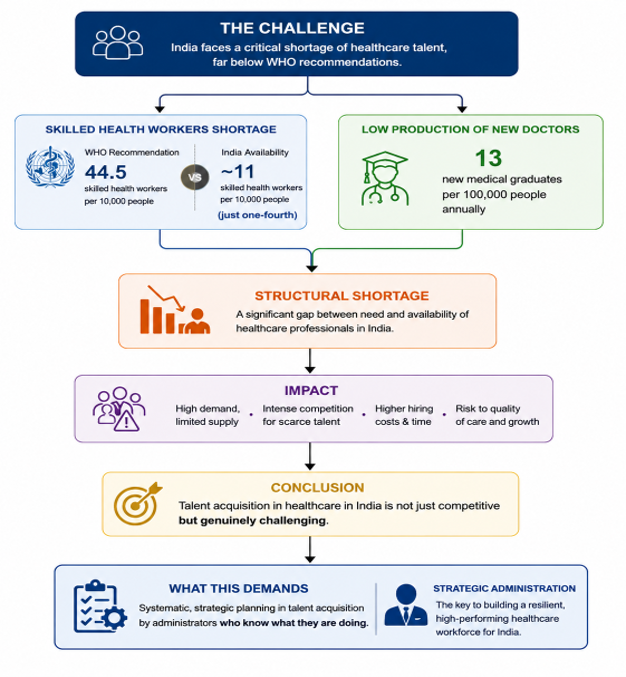
Despite the sector’s growth, healthcare facilities across India are facing severe staff shortages, leading to overwork, compromised patient care, and significant employee dissatisfaction. This clearly highlights that simply having more hospitals does not solve the workforce problem. What India urgently needs is a generation of skilled administrators trained to manage healthcare teams more intelligently and more humanely.
Students training at a dedicated hospital management institute like RUNAX Institute gain exposure to exactly these workforce management principles through a curriculum designed for the realities of Indian healthcare.
The Growing Complexity of Healthcare Talent Management in India
Modern Indian hospitals employ extraordinarily diverse teams. Surgeons, nurses, diagnostic technicians, pharmacists, billing executives, biomedical engineers, housekeeping supervisors, patient counsellors, and compliance officers all work under the same roof with completely different professional expectations and motivation drivers. Managing this complexity is what makes healthcare talent management in India both deeply challenging and enormously rewarding.
Why is managing such diverse healthcare teams in India especially difficult?
Because, unlike Western healthcare systems with more standardised workforce frameworks, India’s hospital ecosystem spans five-star corporate chains, government medical colleges, mid-size private facilities, and community health centres, each with radically different management cultures, compensation structures, and workforce expectations.
RUNAX Institute’s programs expose students to these multidimensional talent management challenges through an industry-aligned academic framework.
Strategic Recruitment and Workforce Planning in Indian Healthcare
How do Indian hospitals address chronic staffing shortages without compromising patient care quality? The answer lies in abandoning reactive hiring habits and adopting strategic, forward-looking healthcare manpower planning. Most hospitals that consistently struggle to fill open positions do not have a talent shortage. They are facing a planning problem.
Progressive healthcare institutions in India are now moving toward workforce forecasting models that anticipate staffing requirements months ahead. Competency mapping helps identify what specific clinical and administrative skills each department truly needs. Role-specific hiring strategies ensure that the right candidates are identified, assessed, and onboarded in a structured and efficient manner.
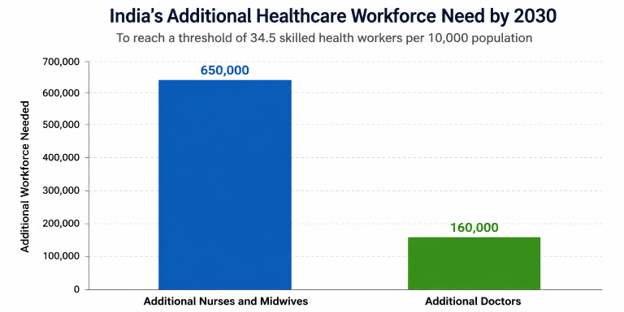
India needs at least 1.8 million doctors, nurses, and midwives to achieve universal health coverage targets, according to a WHO mid-term review, and the COVID-19 pandemic further exposed the acute shortage of trained personnel across tertiary hospitals. Meeting this massive workforce requirement requires not just more training seats in medical colleges but a whole generation of administrators who understand how to build and manage sustainable talent pipelines.
The Indian healthcare sector is projected to reach $372 billion by 2025, creating thousands of new roles in hospital administration and management, with hospitals no longer operating as simple service centres but requiring skilled managers who understand healthcare systems, operations, finance, and technology.
Students pursuing a hospital management course in Kolkata at RUNAX Institute are trained in exactly these competencies, learning how strategic recruitment planning and workforce forecasting directly influence the quality and continuity of healthcare service delivery.
Employee Retention and Healthcare Workforce Stability in India
Employee retention is perhaps the most urgent workforce challenge facing Indian hospitals right now. The numbers tell a story that hospital administrators simply cannot afford to ignore. India currently has 1.7 nurses per 1,000 people against the WHO-recommended rate of 3 per 1,000, and a significant portion of India’s trained nursing professionals are actively seeking employment abroad due to the lack of satisfactory positions and competitive pay domestically.
What drives high attrition among Indian healthcare professionals?
Burnout, stagnant career pathways, inadequate compensation in mid-size private facilities, poor workplace culture, and a lack of recognition for the immense physical and emotional demands of clinical work. These are not new problems. They are deeply entrenched systemic challenges that require sophisticated management solutions.
Financial incentives, professional development programs, and mentorship have been identified as key tools for attracting and retaining healthcare talent in India, with the employment rate in the sector expected to grow by 12.59 per cent in 2024 to 2025 as per the Union Budget allocation. This growth in healthcare employment is an opportunity only if administrators know how to build workplaces that make talented professionals want to stay.
India plays a pivotal role in global healthcare talent supply, with states like Kerala, Tamil Nadu, and Andhra Pradesh leading in the emigration of trained healthcare professionals to countries such as Germany and Switzerland under bilateral agreements. Every skilled nurse or technician who leaves the country to work abroad represents both a systemic failure of retention and a direct challenge for Indian hospital administrators managing their depleted workforce.
RUNAX Institute builds future healthcare managers who understand that healthcare employee engagement and workforce stability are not HR luxuries. They are clinical necessities. Students learn to design retention frameworks that go beyond salary increments and address the deeper factors that keep dedicated professionals committed to their institutions.
Leadership Development and Healthcare Team Performance
Ask any overworked nurse in an Indian government hospital what would genuinely improve their situation, and the answer usually involves leadership quality. The presence or absence of strong, empathetic, and operationally skilled leadership in a hospital department directly determines staff morale, patient satisfaction, and institutional performance.
Why is leadership development so critical to Indian hospital management?
Because Indian hospitals operate within a uniquely high-pressure environment where resource constraints, patient volumes, regulatory requirements, and staff burnout collide simultaneously. Leaders in this environment cannot rely on authority alone. They need coaching skills, conflict resolution capabilities, operational intelligence, and genuine human empathy.
Hospital administration in India is rapidly moving from administrative support to strategic healthcare leadership, with management complexity increasing sharply as hospitals expand in tier-2 and tier-3 cities and corporate chains consolidate multi-state operations. This structural shift demands a new breed of healthcare administrators who are built for leadership from day one.
RUNAX Institute integrates leadership-focused learning directly into its hospital management programs. Students develop the skills to motivate multidisciplinary healthcare teams, manage complex interpersonal dynamics, and make high-stakes operational decisions under pressure. The institute understands that India’s healthcare system does not just need more administrators. It needs better leaders.
Workforce Productivity Through Operational Efficiency
Operational efficiency and workforce productivity are inseparable in hospital management. In an Indian context, where resources are frequently stretched thin and patient volumes are consistently high, the ability to eliminate waste and optimise workflows is not a management bonus. It is a basic operational requirement.
Modern Indian hospitals must operate at the intersection of operations, finance, compliance, and service delivery, managing insurance reimbursement systems, digital compliance mandates, biomedical waste rules, and patient safety standards simultaneously. Administrators who cannot manage this complexity efficiently end up creating bottlenecks that frustrate staff, delay patient care, and drain institutional finances.
How do Indian hospitals improve workforce productivity without increasing headcount?
Through smarter scheduling systems, clearer workload distribution protocols, stronger interdepartmental coordination, and real-time performance monitoring dashboards that identify inefficiencies before they become a crisis. Due to the high demand for positions in digital health care, diagnostics, and specialised care, India’s healthcare hiring intent increased to 52% in the first half of 2025, up 5% from the second half of 2024.
Students pursuing a hospital management course in Kolkata at RUNAX Institute gain direct exposure to these operational management principles. They learn how scheduling technology, resource allocation strategies, and performance systems work together to build a more productive, lower-stress healthcare environment for both staff and patients.
Professional Development and Continuous Learning in Indian Healthcare
India’s healthcare landscape changes fast. New government regulations, updated clinical protocols, evolving insurance frameworks, and rapidly advancing medical technology mean that a healthcare workforce that stops learning today will be operationally outdated tomorrow.
How do Indian hospitals maintain a competent and future-ready workforce despite resource constraints?
Through internal training programs, structured certification pathways, inter-departmental knowledge-sharing initiatives, and partnerships with educational institutions that keep the workforce continuously updated and professionally growing.
Healthcare facilities across India are actively implementing comprehensive upskilling programs and leveraging technology to streamline recruitment and expand workforce capacity in response to growing staff shortages. This commitment to continuous learning is not optional. It is the only realistic path to building a sustainable healthcare workforce in a country where the demand for trained professionals far outpaces current supply.
RUNAX Institute promotes an industry-oriented approach to healthcare administration training that encourages students to treat continuous learning as a professional mindset rather than a formal obligation. Graduates of the institute leave with both the foundational knowledge and the intellectual adaptability needed to grow alongside an industry that never stands still.
The Role of Healthcare Administration Education in India’s Workforce Excellence
India’s hospitals increasingly want administrators who bring more to the table than just organisational skills. Healthcare management roles in India in 2025 range from entry-level salaries of approximately Rs. 4.5 lakh per year to senior-level positions commanding Rs. 30 lakh and above in large hospital groups and healthcare consultancies.
This wide salary range reflects the enormous variation in what hospitals need from their administrators. The ones that pay the most are the ones hiring professionals who genuinely understand hospital operations, financial governance, human resource management, and strategic planning together.
Specialised healthcare administration education bridges the gap between classroom theory and clinical reality. Students who train at a dedicated hospital management institute like RUNAX Institute enter the workforce with a comprehensive understanding of what hospitals actually need from their management teams. They are not starting from zero. They are starting from an informed, capable, and career-ready position.
Why RUNAX Institute Is Preparing Future Healthcare Workforce Leaders
RUNAX Institute of Hotel Management has positioned itself as a forward-thinking educational institution that takes India’s healthcare workforce challenge seriously. The institute’s hospital management course in Kolkata is built around practical learning, industry-relevant curriculum, and the deliberate development of strategic management capabilities that Indian hospitals urgently need right now.
The demand for Indian healthcare professionals is expected to double nationally and globally by 2030, and AI integration in Indian healthcare is expected to create nearly 3 million new jobs by 2028. The administrators who will manage these professionals and lead these expanding institutions are being trained today.
RUNAX Institute ensures that its students are among the most prepared, most capable, and most industry-ready graduates entering India’s booming healthcare management sector.
Conclusion
India’s healthcare sector is at a historic inflexion point. The demand for patients is rising, the infrastructure is growing, and investments are increasing. But none of it will translate into better health outcomes without skilled administrators who can manage the people, processes, and organisational priorities of modern Indian hospitals simultaneously.
India needs at least 1.8 million more healthcare professionals to achieve universal health coverage, and the COVID-19 pandemic has made the shortage of trained management personnel across tertiary hospitals undeniably clear. Meeting this challenge requires not just clinical expansion but a strategic investment in healthcare administration education.
A hospital management course in Kolkata at RUNAX Institute equips aspiring professionals with the expertise, practical exposure, and strategic thinking capability to step confidently into India’s growing healthcare management sector. The future of Indian healthcare depends as much on great administrators as it does on great doctors. RUNAX Institute is actively committed to building both.
Frequently Asked Questions
1. What is workforce optimisation in hospital management in India?
Workforce optimisation means aligning staffing levels with patient demand and departmental workloads to maximise productivity, reduce operational waste, and consistently maintain high-quality patient care.
2. Why is healthcare talent management critical for Indian hospitals?
India faces severe shortages of trained healthcare professionals. Effective talent management reduces attrition, strengthens institutional stability, and directly improves the quality and continuity of patient care delivery.
3. What career opportunities does a hospital management course in Kolkata open up?
It opens roles in hospital administration, operations management, healthcare HR, patient services, quality assurance, and healthcare consulting, with salaries ranging from Rs. 4.5 lakh to Rs. 30 lakh or more.
4. How does employee retention affect Indian hospitals specifically?
High attrition in Indian hospitals drains limited resources, disrupts care continuity, and forces institutions to operate with understaffed teams, directly compromising patient safety and institutional performance.
5. How does RUNAX Institute prepare students for India’s healthcare workforce challenges?
RUNAX Institute offers an industry-aligned curriculum covering workforce planning, operational management, leadership development, talent retention, and healthcare administration tailored to the specific realities of Indian healthcare.