





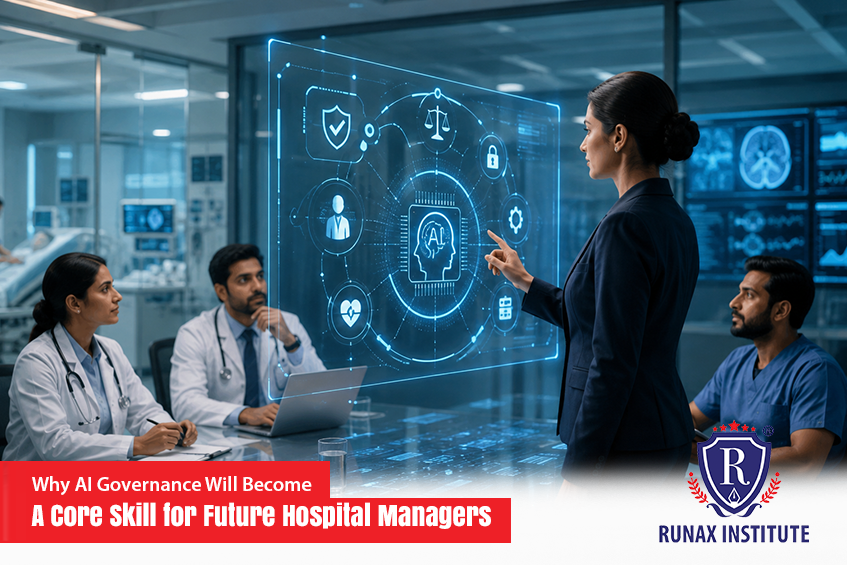
Picture this. A hospital in Kolkata rolls out an AI tool that flags high-risk cardiac patients before symptoms even show up. Sounds brilliant, right? Now picture the same tool quietly mislabeling patients because the training data never included enough women or elderly patients from eastern India. That’s not science fiction. That’s the everyday risk hospitals face today when they adopt AI without proper oversight.
Administrators who only know budgets and bed occupancy are suddenly expected to question algorithms, audit data pipelines, and defend clinical decisions made partly by machines. If you’re eyeing a career in healthcare administration, this shift changes everything about what “management” even means.
Stay with this article, and you’ll understand exactly why AI governance is becoming the single most valuable skill a hospital administrator can carry, and how a proper hospital management course in Kolkata builds that exact capability from day one.
What Is AI Governance and Why Hospitals Cannot Ignore It Anymore
AI governance refers to the rules, checks, and human oversight that govern how artificial intelligence is built, tested, deployed, and monitored in a healthcare setting. It is not just a technical checklist buried in an IT department. It touches patient safety, legal liability, ethics and daily clinical workflows all at once.
India’s health ministry made this urgent and real. The government launched two digital health initiatives called SAHI, the Strategy for Artificial Intelligence in Healthcare for India, and BODH, the Benchmarking Open Data Platform for Health AI, during the India AI Impact Summit 2026, marking a major step toward safe and evidence-based responsible AI deployment in the country’s healthcare ecosystem. This single policy move confirmed something hospital managers had suspected for years. AI in healthcare is no longer experimental. It is operational infrastructure.
Why does hospital AI governance matter right now? Because SAHI rests on five foundational pillars, namely governance and evidence-based validation, safe digital infrastructure, workforce readiness, ethical oversight, and equity-centred deployment. Notice how three of those five pillars directly involve management decisions rather than pure engineering work. Workforce readiness means training staff to work alongside algorithms. Ethical oversight means someone in the room must ask hard questions about bias and fairness. Equity-centred deployment means managers must check whether an AI tool actually serves rural and underserved patients or just the ones already getting good care.
Hospitals that treat AI governance as optional will face regulatory friction, patient trust issues and operational chaos. Hospitals that build it into daily management will run smoother, safer and more defensible operations. That gap is exactly where trained managers step in.
How India’s National AI Health Strategy Is Reshaping Hospital Operations
India isn’t dabbling in AI health policy. It’s building national-scale infrastructure. The eSanjeevani telemedicine platform has logged over 282 million consultations using AI-generated differential diagnosis recommendations, which shows the sheer volume of AI touching real patient care every single day. That number alone should tell every future hospital administrator that AI is no longer a side project.
The clinical impact is measurable too. Over 4,500 disease outbreak alerts have been generated by the AI-powered Media Disease Surveillance System, and adverse tuberculosis outcomes declined by 27% after AI-enabled tools were integrated into the National TB Elimination Programme. Those are not abstract statistics. They represent lives saved through faster detection and smarter triage.
How is Kolkata connected to this national AI health push? Eastern India’s hospitals, diagnostic chains and teaching institutions are steadily adopting AI-assisted radiology, predictive bed management and automated patient flow systems. Local hospital groups are integrating tools that flag readmission risk or optimise operation theatre scheduling. None of this runs on autopilot. Every AI recommendation needs a human manager checking outcomes, validating data quality and deciding when to override the machine.
This is precisely why institutions offering a solid hospital management college in Kolkata now weave AI literacy, data ethics and technology oversight into their core curriculum instead of treating it as an elective afterthought. Managers trained this way don’t just operate hospital software. They interrogate it, question its assumptions and keep patients at the centre of every automated decision.
The New Skillset: Algorithmic Accountability and Clinical Decision Support
Traditional hospital management taught students how to handle staffing, procurement, finance and patient satisfaction. That foundation still matters enormously. But a new layer has been added on top, and it demands fluency in algorithmic accountability.
Algorithmic accountability simply means someone can explain why an AI system made a particular recommendation, and someone can be held responsible if it goes wrong. When an AI tool suggests a treatment pathway or flags a patient as high risk, the hospital cannot shrug and say “the computer decided.” Regulators, patients and courts will expect a clear answer.
What skills do hospital managers need to handle clinical decision support tools? They need to understand model validation, meaning the process of testing whether an AI tool actually performs as claimed across different patient groups before it touches real care. They need data quality awareness, because a brilliant algorithm fed messy or incomplete records will produce dangerous outputs. They need bias detection skills, since AI trained mostly on urban, English-speaking, higher-income patient data can perform poorly for rural or economically weaker populations, a real risk in a diverse state like West Bengal.
This is not abstract theory. Three institutions have already been formally recognised for this exact work. AIIMS Delhi, PGIMER Chandigarh, and AIIMS Rishikesh have been designated Centres of Excellence for Artificial Intelligence in healthcare, signalling that India expects structured, validated, centre-led AI adoption rather than scattered experimentation. Future hospital managers trained in Kolkata will increasingly collaborate with such centres, adapt their protocols locally and translate technical validation reports into operational policy for their own facilities.
Human Oversight: Why Machines Still Need a Manager in the Loop
Here’s a myth worth busting immediately. AI does not replace hospital managers. It multiplies their responsibilities. The national strategy explicitly ensures that AI assists rather than replaces doctors and health workers, and the same principle extends directly to hospital administration. A predictive staffing tool still needs a manager who understands when local context, festival season patient surges, or a sudden disease outbreak makes the algorithm’s forecast unreliable.
Human oversight in AI governance covers several concrete duties. Managers must set escalation protocols, meaning clear steps for staff to follow when an AI recommendation seems wrong or unusual. They must run periodic audits, checking whether the AI’s predictions actually matched real patient outcomes over time. They must maintain a feedback loop with vendors and technical teams so that errors get corrected quickly rather than repeated for months.
Why can’t hospitals just let AI vendors handle governance on their own? Because vendors optimise for their product working in general conditions, while hospital managers understand their specific patient population, local disease patterns and infrastructure limits. A diabetes prediction model calibrated on North Indian data might behave differently on a Bengali population with different dietary and genetic patterns. Only a manager embedded in daily hospital operations catches that mismatch early.
This human-centred approach also protects patient trust. Patients are far more comfortable with AI-assisted diagnosis when they know a qualified human remains accountable for the final decision. Building and protecting that trust is fundamentally a management function, not a coding function.
Data Governance, Privacy and the Digital Health Backbone
None of this AI activity runs on thin air. It runs on data, and lots of it. India has created a universal digital health ID for every citizen, enabling longitudinal health records that feed AI diagnostics and population health analytics, with over 530 million health IDs issued so far. That is a staggering scale of interconnected patient information, and every byte of it carries privacy and consent obligations.
Future hospital managers must understand consent-based data exchange, meaning patients actively agree before their records get shared or used to train AI systems. They must grasp interoperability, the ability for different hospital systems to talk to each other safely without leaking sensitive information. They must know how to respond when a data breach or model malfunction threatens patient confidentiality.
What role does data quality play in hospital AI governance? A massive one. Poor quality data, duplicate records, outdated diagnoses or incomplete history sections can quietly corrupt an AI model’s accuracy without anyone noticing until a patient is harmed. Managers trained in data governance learn to audit record completeness, standardise data entry practices across departments and push back when digital systems compromise on data hygiene for the sake of speed.
This layer of responsibility explains why a modern hospital management course in Kolkata increasingly includes modules on health informatics, digital infrastructure and information security alongside classic subjects like hospital finance and patient services. The manager of tomorrow needs comfort with both spreadsheets and system architecture diagrams.
Building Career Readiness Through Specialised Education in Kolkata
Kolkata has quietly become a strong hub for healthcare and hospitality education, and hospital administration training is expanding to match new industry demands. A well-structured hospital management college in Kolkata today blends operational fundamentals, patient experience design, healthcare law and, increasingly, technology governance modules that prepare graduates for AI-integrated hospital environments.
Is a hospital management course worth it if AI is doing more of the work? Absolutely, and arguably more than ever before. Someone still has to interpret AI outputs, communicate them clearly to clinicians and families, manage the ethical grey areas and keep hospital operations financially sustainable while adopting new technology. AI increases the value of skilled human managers rather than diminishing it.
Students entering this field today benefit from internships at hospitals actively piloting AI tools, exposure to real dashboards tracking patient flow predictions, and coursework covering healthcare policy alongside emerging technology standards. Graduates leave equipped not just to manage a ward or a billing department, but to sit confidently in meetings where data scientists, clinicians and regulators debate how a new AI tool should be deployed responsibly.
This blend of soft skills, operational know-how and technical fluency is exactly what recruiters are hunting for as hospitals across eastern India scale up their digital health ambitions through 2026 and beyond.
Conclusion
AI is no longer a futuristic add-on inside Indian hospitals. It is woven into diagnostics, patient triage, disease surveillance and daily operations right now. National policy through SAHI and BODH confirms that responsible, well-governed AI adoption is now an official expectation, not a distant goal.
This shift demands hospital managers who understand algorithmic accountability, human oversight, data privacy and bias detection alongside traditional administrative skills. A capable hospital management course builds exactly this hybrid expertise, blending operations, ethics and technology literacy into one career path.
Choosing a strong hospital management college in Kolkata positions graduates at the centre of India’s healthcare transformation, ready to coordinate clinicians, patients, data teams and regulators with confidence. The hospitals that thrive over the coming years will be led by managers who treat AI governance as a core skill, not an afterthought.
Frequently Asked Questions (FAQs)
1. What does AI governance mean for hospital managers?
It means overseeing how AI tools are validated, monitored and used safely, ensuring accountability, fairness and human oversight in every AI-assisted clinical or operational decision.
2. Why is AI governance training important in a hospital management course?
Because hospitals increasingly rely on AI for diagnostics and operations, managers need skills in data quality, bias detection and algorithmic accountability to lead safely.
3. Will AI replace hospital administrators in the future?
No, AI assists decision-making but still requires human oversight, ethical judgement and contextual understanding that only trained managers can provide.
4. What is India’s national strategy for AI in healthcare called?
It is called SAHI, the Strategy for Artificial Intelligence in Healthcare for India, launched alongside BODH during the India AI Impact Summit 2026.
5. How does studying in Kolkata help with AI-focused hospital careers?
Kolkata offers growing healthcare education infrastructure with courses integrating technology governance, giving graduates practical readiness for AI-driven hospital environments.