






Introduction
The hospitality industry is no longer powered only by smiling faces, crisp uniforms, and manual registers tucked behind the front desk. Hotels today run on dashboards, sensors, automation, and real-time data that never sleeps. Yet many students still enter hospitality programs expecting only service etiquette and operational theory. That gap is risky. Without understanding digital hotel operations and cyber-physical hospitality systems, graduates risk becoming outdated before their first promotion.
This is exactly where a hospitality management course in Kolkata is evolving fast. Institutes are quietly transforming classrooms into smart hotel environments where technology and hospitality coexist. Students now train in smart classroom hospitality setups that replicate real hotels, utilising IoT in hospitality education, automation, and analytics. The goal is simple: create professionals who understand guests and systems equally well.
If students ignore this shift, they fall behind in an industry racing toward intelligent hotel infrastructure. But those who embrace it gain something powerful: the ability to manage modern hotels as living, connected systems. Keep reading, because this transformation is reshaping what it truly means to study hospitality in India.
The Rise of the Cyber-Physical Hotel Model in Hospitality Education
Hotels no longer operate as isolated departments working independently. They now function as cyber-physical environments where physical spaces interact constantly with digital platforms. A guest’s room entry triggers energy systems, housekeeping alerts, and service workflows simultaneously. Hospitality management colleges in Kolkata are responding to this shift by redesigning how hospitality education works at the foundation level.
A modern hospitality management course in Kolkata introduces students to this cyber-physical hotel model early. Classrooms simulate digitally connected hotels where sensors, property systems, and service software work together. This approach moves beyond manual workflows and prepares students for digital transformation in hotels, which is now standard across Indian hospitality chains.
By teaching students how physical guest actions generate digital responses, institutes create clarity around hospitality systems training. Students stop seeing technology as an add-on and start treating it as the backbone of modern service delivery. That mindset shift defines future-ready hospitality professionals.
Smart Classrooms That Mirror Smart Hotels
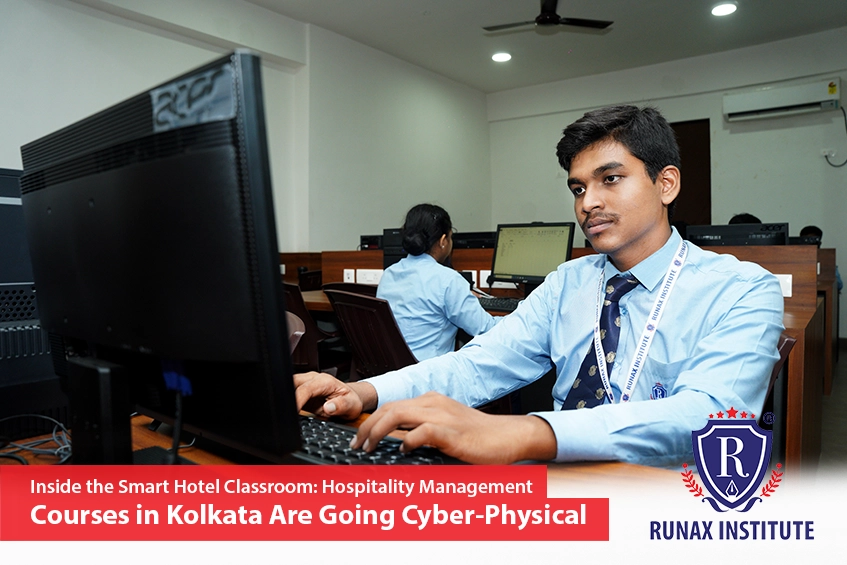
Traditional hospitality classrooms focused on theory-heavy lectures and isolated practical sessions. That approach no longer matches how hotels operate today. In response, hospitality management colleges in Kolkata are building smart classrooms that mirror actual hotel environments, powered by automation and connected systems.
Students now train in labs that replicate digital front offices, connected inventory controls, and automated service modules. These setups support hotel technology training and expose learners to tech-enabled hospitality courses that reflect real-world workflows. A check-in action automatically updates housekeeping, maintenance, and billing systems, just like in modern hotels.
This cyber-physical learning helps students understand cause-and-effect across departments. Instead of memorising SOPs, they experience hospitality automation learning in action. By the time students graduate, they understand how hotels rely on synchronised systems rather than isolated tasks, making them operationally sharp from day one.
Teaching Hotel Operations Through Real-Time Data Systems
Modern hotels thrive on live data. Decisions no longer rely on instinct alone. Occupancy trends, service response times, energy usage, and guest behaviour now guide operations. A forward-thinking hospitality management course in Kolkata ensures students become comfortable working with these data streams early.
Students learn how hotel operations analytics shape daily decisions. They analyse dashboards showing occupancy fluctuations, resource utilisation, and service efficiency generated by connected systems. This exposure builds confidence in data-driven hotel management, which is rapidly becoming essential across Indian hospitality operations.
Handling real-time data also teaches accountability. Students see how delays impact guest satisfaction and costs simultaneously. This training prepares learners to align operational decisions with experience goals using technology. As a result, graduates understand how smart hotels balance efficiency and service without compromise.
Integrating Automation Without Losing the Human Touch
Automation often scares hospitality purists. Many fear technology will strip hotels of warmth and personalisation. Smart hospitality education tackles this fear head-on. Hospitality management courses in Kolkata teach students that automation supports service rather than replacing it.
Students learn to manage automated check-ins, smart room controls, and digital concierge platforms while maintaining emotional intelligence. Courses emphasise that technology handles repetitive tasks, freeing staff to focus on meaningful guest interactions. This balance defines successful digital hotel operations.
By mastering hospitality automation learning, students learn when to intervene personally and when to trust systems. They understand that cyber-physical hotels succeed only when technology enhances empathy. This training ensures future managers use systems as tools, not crutches, preserving hospitality’s human core in a digital world.
Cyber-Physical Training for Multi-Departmental Coordination
In smart hotels, no department operates in isolation. Through linked platforms, housekeeping, front desk, maintenance, and food and beverage are constantly communicating. Hospitality management colleges in Kolkata now simulate this environment to teach system-level thinking.
Students learn how service requests trigger automated workflows across departments. A delayed room clean impacts check-in data, guest satisfaction scores, and staffing decisions simultaneously. This exposure builds strong hospitality systems training capabilities.
Through cyber-physical learning, students grasp workflow synchronisation instead of linear task execution. They learn to manage interconnected operations efficiently, preparing them for large-scale Indian hospitality properties where coordination defines success. This systems-first approach produces managers who solve problems holistically rather than reactively.
Preparing Students for Tech-Driven Hospitality Careers in India
Hospitality careers today demand more than operational knowledge. Employers seek professionals who understand infrastructure, systems, and analytics alongside service excellence. A modern hospitality management course in Kolkata aligns education with this reality.
Students gain exposure to intelligent hotel infrastructure, digital hotel operations, and emerging hospitality technologies used across hotels, airports, and integrated hospitality spaces. This training builds confidence in managing tech-heavy environments without intimidation.
Graduates emerge as adaptable professionals ready for leadership roles where technology drives decisions. They communicate effectively with IT teams, operations staff, and management. This hybrid skillset positions them strongly within India’s evolving hospitality ecosystem.
Why Cyber-Physical Learning Is Becoming Non-Negotiable
The Indian hospitality market grows more competitive every year. Guests expect speed, consistency, and personalisation simultaneously. Managing these expectations manually is impossible. Cyber-physical systems now define operational survival.
Hospitality management colleges in Kolkata understand this shift. They teach students to operate hotels as intelligent systems where data, automation, and service blend seamlessly. This education future-proofs graduates against rapid industry changes driven by technology adoption.
Cyber-physical learning ensures students stay relevant in a digitising industry. It transforms hospitality education from skill training into systems mastery. For anyone serious about long-term success in hospitality, this approach is no longer optional.
Conclusion
Hospitality education in Kolkata is undergoing a quiet but powerful transformation. The classroom no longer prepares students only for front-desk roles. It prepares them to manage entire ecosystems powered by technology, data, and human intelligence working together. A modern hospitality management course in Kolkata now reflects how hotels truly operate today.
By integrating smart hotel education, cyber-physical hospitality systems, and hotel management technology curriculum, institutes ensure students graduate industry-ready. Learners gain confidence in managing IoT in hospitality education, automation, and analytics without losing service empathy.
This shift creates professionals who understand guests, systems, and strategy equally well. As Indian hospitality continues its digital evolution, these future-ready graduates will lead hotels that think faster, serve better, and operate smarter. That is the new definition of hospitality education done right.
Frequently Asked Questions
1. What does cyber-physical hospitality education mean?
Cyber-physical hospitality education teaches students to manage hotels where physical operations connect continuously with digital systems, automation, and real-time data.
2. Why is technology important in hospitality management courses today?
Technology drives efficiency, guest satisfaction, and profitability. Without digital skills, hospitality professionals struggle to manage modern hotel operations.
3. How do smart classrooms benefit hospitality students?
Smart classrooms simulate real hotel environments, helping students understand system coordination, automation, and data-driven decision-making before entering the industry.
4. Does automation reduce the human element in hospitality?
No. Automation handles repetitive tasks, allowing staff to focus more on personalised guest experiences and service quality.
5. Are these skills relevant only for luxury hotels?
Not at all. Cyber-physical systems now operate across budget hotels, airports, resorts, and mixed-use hospitality spaces in India.